
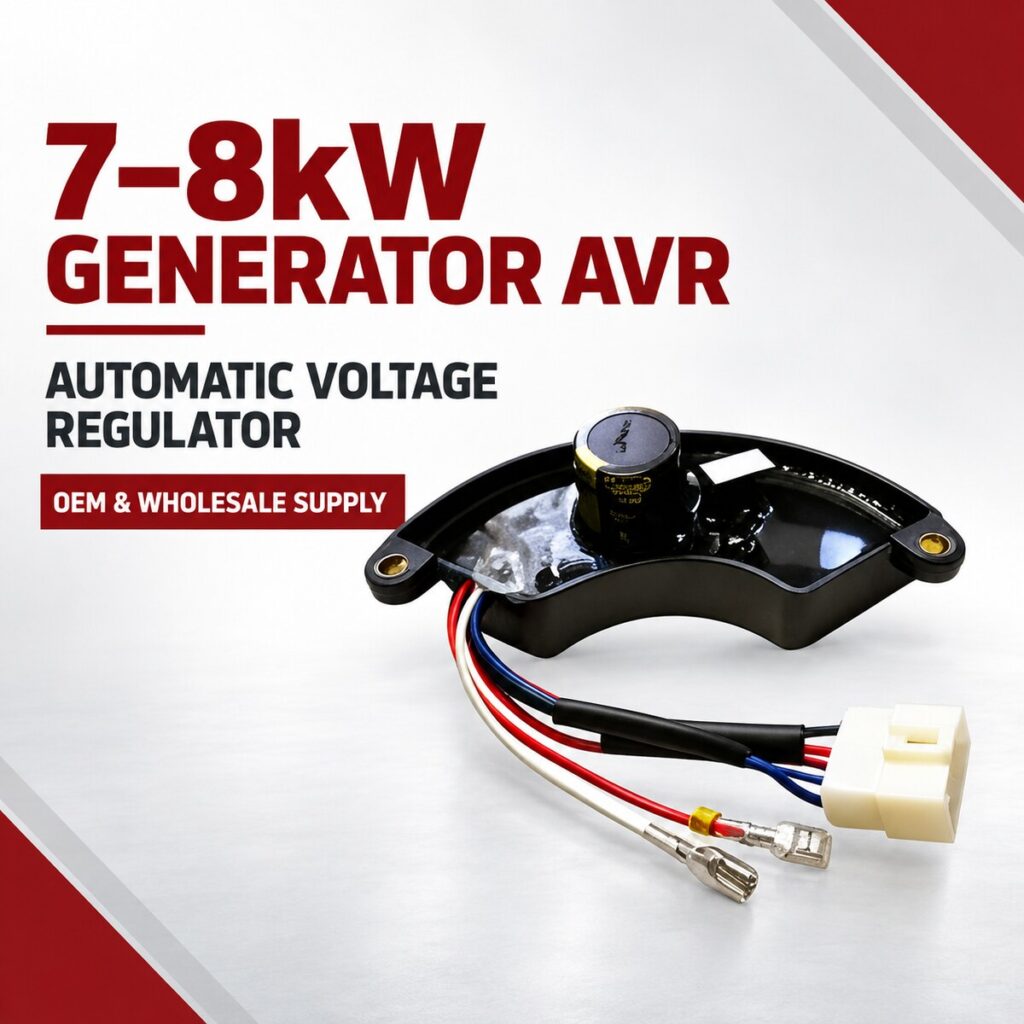
How to Choose a Replacement Generator AVR
To choose a replacement generator AVR, match the alternator’s requirements: rated voltage, phase configuration, frequency, excitation system, sensing connections, wiring and mounting dimensions. Generator power rating, wire count and appearance help narrow the search, but none of them alone confirms compatibility. Check the original part number and wiring documentation before ordering.
For importers, distributors and repair-parts buyers, a clear specification check also helps prevent mixed stock, incorrect cross-references and repeat returns.
What Does a Generator AVR Do?
A generator automatic voltage regulator, or AVR, controls alternator excitation to help maintain the required output voltage as operating conditions change.
AVRs are designed for particular electrical arrangements. Manufacturer documentation distinguishes between self-excited and separately supplied systems, as well as different sensing and control requirements. A regulator intended for one arrangement should not be assumed suitable for another.
This guide focuses on selecting replacement parts for conventional AVR-equipped generators. Inverter generators may use a different control architecture and require a different replacement-part process.
1. Identify the Generator and Alternator
Start with the generator nameplate, alternator identification and existing AVR markings.
Record the following:
- Generator manufacturer and model.
- Alternator manufacturer and model, where available.
- Rated output, noting whether it is stated in kW or kVA.
- Rated voltage, frequency and phase configuration.
- Original AVR part number and any revision code.
The alternator model and original regulator reference are more useful than an engine model alone. The same engine can be used in generator sets with different alternators and electrical components.
If the AVR label is unreadable, collect clear photographs and the available wiring diagram. Ask the supplier to identify missing information rather than selecting a part from appearance alone.
2. Check Voltage, Phase and Frequency
Confirm the generator’s rated output and the replacement regulator’s documented operating requirements.
A generator’s output voltage is not necessarily the same as the AVR’s supply or sensing voltage. These are separate specifications and should be checked against the relevant wiring diagram and regulator data.
Also distinguish the generator’s output phase configuration from the AVR’s sensing arrangement. For example, an AVR described as using two-phase sensing does not mean the generator has a two-phase output.
Confirm whether the proposed replacement supports the required 50 Hz or 60 Hz operation, including any manufacturer-specified settings. Do not assume a regulator is suitable for both frequencies without documentation.
3. Compare Wiring and Connectors
Search terms such as “6-wire generator AVR” or “7-wire generator AVR” are useful starting points. However, wire count describes only part of the assembly.
Before accepting a proposed replacement, compare:
| Check | Information to confirm |
|---|---|
| Leads and terminals | Number of wires, plugs and separate terminals |
| Connector housing | Shape, size, locking features and orientation |
| Pin assignment | Function of each connection |
| Lead length | Whether the harness reaches its intended position |
| Wiring reference | Connection diagram or verified original-part match |
Two regulators can have the same connector and wire count while using different pin assignments. Wire colors also should not be treated as a universal wiring standard.
Ask for a documented connection comparison. Any installation or electrical testing should be carried out by a qualified technician following the generator manufacturer’s instructions.
4. Verify Excitation and Sensing Compatibility
A suitable generator voltage regulator replacement must match how the alternator supplies the AVR and how the regulator controls excitation.
Depending on the design, relevant specifications can include:
- AVR power supply source and operating range.
- Voltage-sensing arrangement and range.
- Excitation output capability.
- Permitted field resistance.
- Required protection or control functions.
These requirements vary between regulator models. Physical fit does not establish electrical suitability.
For an unfamiliar cross-reference, request the proposed replacement’s datasheet and ask which specifications have been checked against the original. Where documentation is incomplete, treat the part as a candidate for evaluation rather than a confirmed replacement.
5. Measure the Mounting Dimensions
After checking the electrical requirements, verify that the regulator fits the available installation space.
Measure the overall length, width and height, along with mounting-hole spacing and hole diameter. Check connector clearance and the position of the wiring exit.
A photograph with a ruler can help initial identification, but a dimensioned drawing provides a clearer reference for repeat purchasing.
For distributors handling several similar AVRs, keep a separate dimension record for each stock code. Avoid combining different variants under one description simply because their housings look alike.
6. Use Generator Power Rating as a Filter
Descriptions such as “2–3kW AVR” or “7–8kW AVR” help buyers find a product group. They do not prove that every regulator in that group is interchangeable.
Likewise, a regulator advertised for a higher-power generator is not automatically an upgrade for a smaller unit.
Use the power range to shortlist products, then confirm the original reference, electrical requirements, wiring and dimensions.
You can browse the MARATO generator AVR and voltage regulator range to identify possible options for further compatibility checking.
7. Approve a Reference Sample Before Bulk Purchasing
For wholesale orders, establish a reference record for each approved variant.
That record should include the supplier’s item code, confirmed specifications, photographs, connector details, dimensions and the customer’s internal stock code.
Where practical, have a qualified technician evaluate a sample on the intended generator application before approving a bulk order. Agree on acceptance criteria and document the evaluated configuration.
Also confirm MOQ, packaging, lead time and how specification changes will be communicated. A retained sample and written specification give both parties a clearer basis for repeat orders.
Frequently Asked Questions
Are generator AVRs universal?
No. Regulators differ in supply, sensing, excitation, connections and physical dimensions. Confirm compatibility for the particular alternator and application.
Can I replace a 6-wire AVR with a 7-wire AVR?
Do not assume they are interchangeable. A different wire count requires a documented explanation of the connections and confirmation that the regulator meets the alternator’s requirements.
Is generator power rating enough to choose an AVR?
No. Power rating is a useful filter, but voltage, phase, frequency, wiring, excitation requirements and mounting dimensions also need verification.
What if the original AVR has no readable part number?
Provide the generator and alternator nameplates, clear photographs, dimensions and any available wiring documentation. Identification may remain provisional until the missing specifications are confirmed.
Request Help Identifying a Replacement Generator AVR
MARATO supplies generator replacement parts for importers, distributors, wholesalers and repair-parts businesses.
For an AVR inquiry, send your generator and alternator details, rated output, voltage, phase, frequency, old AVR photographs, connector details, mounting dimensions and required quantity.
Contact MARATO with your AVR specifications to discuss a possible replacement and the information needed to check compatibility.
Technical References
These manufacturer resources explain AVR selection principles and model-specific differences. They do not establish compatibility between MARATO products and the manufacturers’ regulators.